
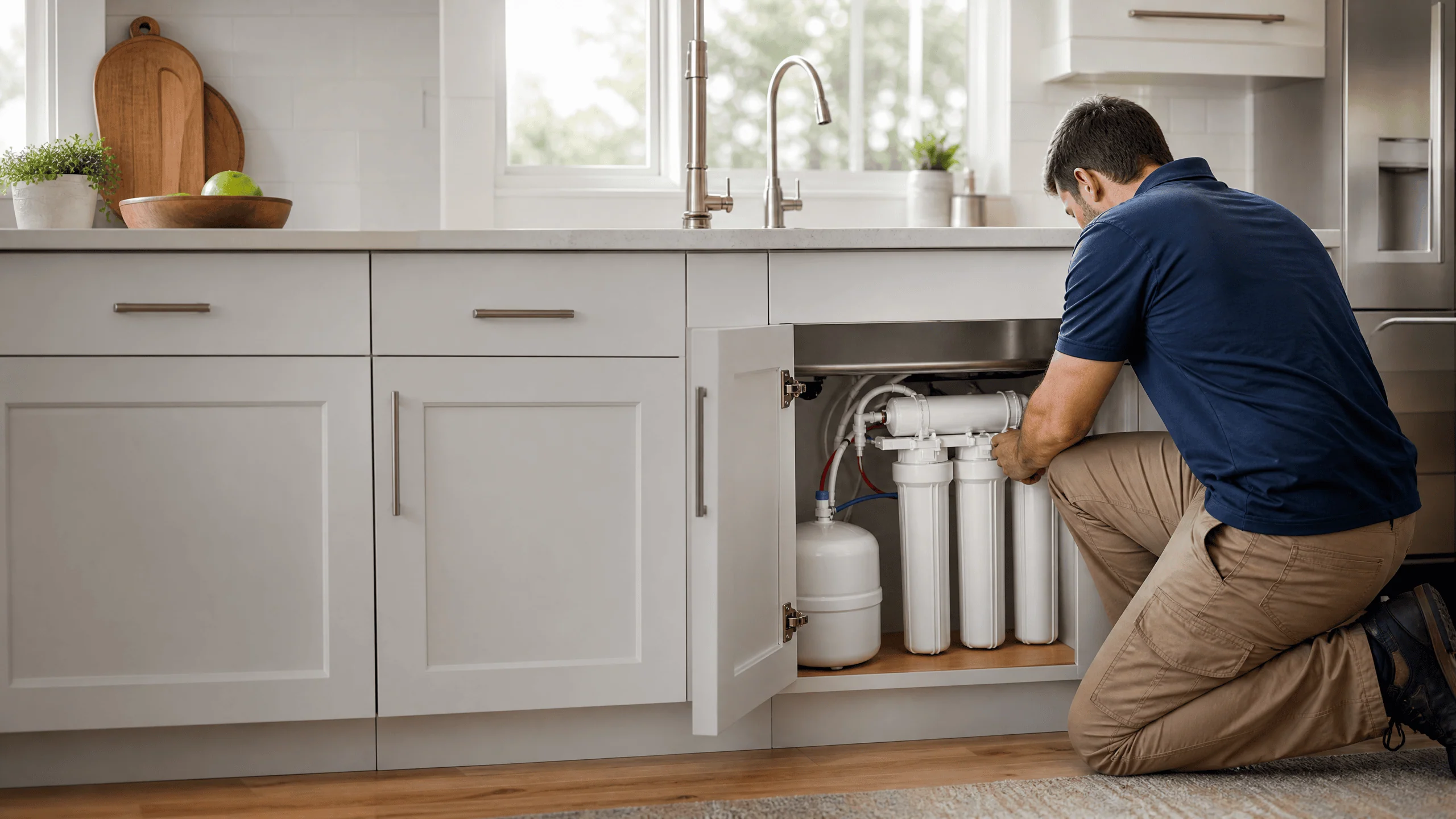
When homeowners become concerned about the quality, taste, or safety of their drinking water, they often look beyond the standard refrigerator filter or water pitcher. For those seeking the highest level of purification available for residential use, the conversation inevitably turns to reverse osmosis. While the technology is highly effective, the process of installation reverse osmosis water filter systems requires careful planning and professional execution to ensure optimal performance.
Unlike a simple carbon filter that attaches to the end of a faucet, a reverse osmosis system is a multi-stage purification plant that requires dedicated plumbing connections, a storage tank, and a wastewater drain line. Attempting a DIY installation or hiring an inexperienced contractor can lead to leaks, low water pressure, or compromised filtration. This guide explains how reverse osmosis works, how it differs from whole-home systems, and what you should expect during a professional installation.
How Reverse Osmosis Purification Works
To understand why the installation reverse osmosis water filter process is more complex than standard filtration, you must understand the technology behind it. Reverse osmosis (RO) does not simply trap particles in a porous material like a sponge. Instead, it uses household water pressure to force water molecules through a semi-permeable membrane that has microscopic pores.
These pores are so small that they allow pure water molecules to pass through while blocking dissolved solids, heavy metals, and other microscopic contaminants. According to the Centers for Disease Control and Prevention, reverse osmosis systems are highly effective at removing a wide range of chemical contaminants, including lead, copper, chromium, and sodium [1]. The impurities that are blocked by the membrane are then flushed away down a dedicated drain line, leaving only highly purified water on the other side.
Because the RO membrane is sensitive to certain chemicals and large particulates, a complete system includes pre-filters. Typically, water first passes through a sediment filter to remove dirt and rust, and then through a carbon filter to remove chlorine, which can damage the delicate RO membrane. After passing through the membrane, the purified water is held in a pressurized storage tank until you open the dedicated drinking water faucet. Before reaching your glass, the water passes through a final post-carbon filter to polish the taste.
Point-of-Use vs. Whole-Home Filtration
A common point of confusion during the planning phase is deciding whether to install a reverse osmosis system for the entire house or just at a specific location. The vast majority of residential RO systems are point-of-use (POU) applications, meaning they are installed under a single sink, usually in the kitchen, to provide purified water for drinking and cooking.
Whole-home reverse osmosis systems do exist, but they are generally impractical and cost-prohibitive for the average homeowner. Because the RO process uses a separate reject-water stream and generally treats water at a comparatively low flow rate, a whole-home system would require substantial storage and equipment capacity to meet a household’s daily demand. Furthermore, using highly purified RO water to flush toilets or water the lawn is an inefficient use of the technology.
For most homes, the most effective strategy is a hybrid approach. A whole-home water filter or water softener is installed at the main water line to protect the plumbing and improve water quality for bathing and laundry. Then, an under-sink installation reverse osmosis water filter provides the ultimate level of purification for consumption. A professional water filtration service will help you determine the right combination of equipment based on a comprehensive water test.
Preparing for the Installation Process
A professional installation reverse osmosis water filter project begins with an assessment of the installation site, typically the cabinet beneath the kitchen sink. The contractor must ensure there is adequate physical space to house the pre-filter housings, the RO membrane module, and the pressurized storage tank. If space is severely limited, the system may need to be installed in an adjacent cabinet or the basement, which requires routing longer lengths of tubing.
The technician will also evaluate the plumbing connections. An RO system requires three specific tie-ins: a feed water connection to supply the system, a drain connection to carry away the wastewater, and a connection to the dedicated dispensing faucet. The contractor will verify that the existing cold water supply line can accommodate an adapter valve and that the sink’s drain pipe is accessible for the installation of a drain saddle.
Finally, the contractor must plan for the dedicated RO faucet. Most systems include a specialized, air-gap faucet that dispenses the purified water. If your sink does not have an existing, unused hole (such as one previously used for a soap dispenser or a side sprayer), the technician will need to drill a new hole through the sink deck or countertop. This requires specialized tools and expertise, particularly if the countertop is made of granite, quartz, or natural stone.
The Professional Installation and Testing Phase
On the day of the installation reverse osmosis water filter appointment, the technician will begin by shutting off the cold water supply under the sink. They will install the feed water adapter valve, ensuring a watertight seal. Next, they will mount the filter assembly inside the cabinet, positioning it so that the filter cartridges remain accessible for future maintenance and replacement.
The drain connection is a critical step in the process. The technician will install a drain saddle on the sink’s tailpiece, carefully drilling a small hole to allow the RO system’s wastewater to exit. It is essential that this connection is made correctly and positioned above the sink’s P-trap to prevent sewer gases from backing up into the RO system. If the system uses an air-gap faucet, the technician will route the drain tubing through the faucet base to meet local plumbing codes.
After installing the dedicated dispensing faucet and positioning the storage tank, the technician will connect the color-coded tubing between all the components. Once the physical connections are complete, the water supply is turned back on. The system must be allowed to fill the storage tank and then be completely flushed several times to remove any manufacturing dust or loose carbon fines from the new filters. The technician will check every connection point for leaks under pressure and use a total dissolved solids (TDS) meter to verify that the membrane is effectively purifying the water before turning the system over to the homeowner.
Maintenance Matters After Installation
A reverse osmosis system is designed to perform over time only when its maintenance schedule is followed. Sediment and carbon pre-filters protect the membrane, while the post-filter helps preserve the finished water’s taste. The correct replacement schedule depends on the system model, water conditions, and household usage, so it should come from the product documentation and the installation professional. The Centers for Disease Control and Prevention advises homeowners to check a treatment system’s label for its contaminant-reduction claims and to maintain filters according to the manufacturer’s recommendations [1]. During a service discussion, ask what maintenance is expected, what signs may indicate that service is due, and whether the system’s performance can be rechecked. That conversation helps preserve the benefits of a carefully planned installation reverse osmosis water filter project.
Call to Action
If you are concerned about the quality of your drinking water, do not rely on temporary pitchers or generic filters. At A2 Home Improvement, we provide professional, permanent solutions tailored to your specific water chemistry. We start every project with a comprehensive water test to ensure we recommend the right technology for your home.
Contact us today to schedule your free water test and consultation in the Pensacola area. Our experienced technicians will evaluate your water, explain the benefits of point-of-use purification, and handle every aspect of the installation reverse osmosis water filter process with precision. Let us provide your family with safe, great-tasting water directly from the tap.
Frequently Asked Questions
1. Do I need a whole-home filter, water softener, or reverse-osmosis system?
Whole-home filters treat all incoming water, softeners remove hard minerals, and reverse osmosis provides highly purified drinking water at a single tap. A2 Home Improvement conducts free water testing in the Pensacola area to determine the exact combination of systems your home needs.
2. What is the best whole-home water filtration system for my home?
The ideal system depends entirely on your specific water chemistry and whether you are on municipal or well water. A2 Home Improvement designs a customized water filter system for home use only after performing a comprehensive diagnostic water test at your Pensacola property.
3. What does a water test check for before installing a filter?
A thorough water test checks for hardness, heavy metals, chlorine, chloramines, and specific odors or contaminants. This diagnostic step allows the water filtration service experts at A2 Home Improvement to recommend the precise technology needed for your Pensacola home.
4. How do I choose a filtration system for well water?
Well water requires specialized treatment because it often contains unique contaminants like iron, sulfur, or sediment that municipal water does not. A2 Home Improvement provides dedicated well-water testing in the Pensacola area to design a system that safely and effectively treats your private water source.
5. Can a reverse osmosis system be connected to my refrigerator?
Yes, during the installation reverse osmosis water filter process, a professional technician can often route a dedicated water line from the RO system to your refrigerator’s ice maker and water dispenser, providing highly purified water for all your kitchen needs in your Pensacola home.
References
[1] Centers for Disease Control and Prevention, “About Choosing Home Water Filters.”